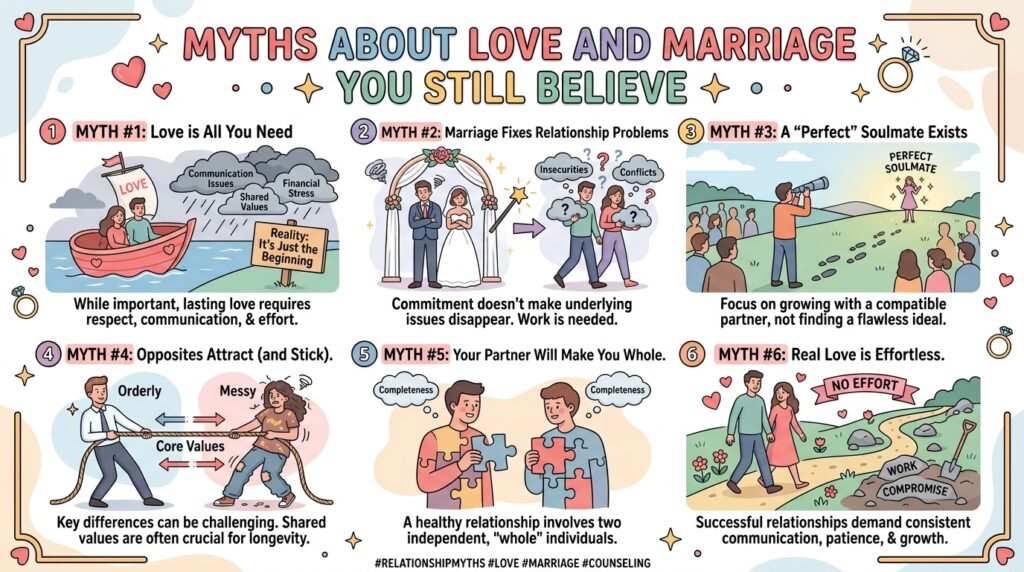
Ask ten people what love is and you’ll get ten different answers. Ask them what a good marriage looks like and you’ll hear ideas shaped by family history, cultural background, religion, romantic media, and years of informal observation. The problem is that much of what we’ve absorbed about love and marriage — quietly, over a lifetime — is factually incorrect. And it’s doing real damage in real relationships.
This article takes on the most widely believed myths about love and marriage, examines what research and relationship experts actually say, and offers a clearer picture of what these institutions truly look like when they’re working.
Myth 1: Love Is All You Need
The Beatles made it sound simple. Popular culture has spent decades reinforcing the idea. But therapists and relationship researchers have spent those same decades documenting the ways that love alone — no matter how genuine and deep — is insufficient to sustain a healthy long-term relationship.
Love is a starting point. What actually holds a relationship together over years and decades includes: effective communication, conflict resolution skills, shared values, financial compatibility, the ability to grow as individuals while also growing as a couple, and a mutual commitment to the relationship even when feelings fluctuate.
Dr. Sue Johnson, founder of Emotionally Focused Therapy (EFT) and author of Hold Me Tight, argues that love in long-term relationships is less about the poetic ideal and more about emotional accessibility — whether partners are available, responsive, and engaged with each other’s needs. These are skills and habits, not just feelings. And they can be learned.
People who believe love alone is enough often don’t invest in the practical skills that relationships require. When difficulties arise — as they always do — they interpret that difficulty as proof the love wasn’t real, rather than as a normal part of maintaining any meaningful relationship.
Myth 2: Opposites Attract and Make the Best Couples
The “opposites attract” idea is enduringly popular. The quiet introvert paired with the outgoing extrovert. The spontaneous free spirit with the organized planner. In movies and novels, these pairings crackle with tension and ultimately balance each other out beautifully.
In real life, research tells a more complicated story. Studies in the field of relationship psychology consistently find that couples who share core values, communication styles, and life goals tend to report higher satisfaction and stability over time. Differences in personality can be complementary — but differences in fundamental values (around money, family, faith, or parenting) tend to be a source of chronic conflict.
This doesn’t mean you need a partner who is your clone. But it does suggest that the excitement of opposites-attract chemistry in the early stages of a relationship is not a reliable predictor of long-term compatibility. Novelty and contrast can be initially thrilling. Shared direction tends to be what gets you through the harder years.
Myth 3: Marriage Should Make You Happy
This is a subtle but important myth to unpack. It’s not that marriage can’t be a source of happiness — studies consistently show that married people, on average, report higher levels of well-being than their single or divorced counterparts. But there is a dangerous version of this idea that goes further: the belief that marriage is responsible for your happiness, and that if you’re unhappy, the marriage is the problem.
Therapists regularly encounter clients who have spent years blaming their unhappiness on their marriage or their spouse — only to discover that what they’re really dealing with is unresolved personal anxiety, depression, childhood wounds, or a lack of individual purpose that no relationship could fix.
Marriage doesn’t produce happiness. It amplifies what’s already there. If you bring unresolved pain, insecurity, or emotional unavailability into a marriage, the marriage will reflect that. If you bring curiosity, resilience, and a willingness to be vulnerable, those qualities will shape the marriage too.
This is not an argument against expecting joy and fulfillment from a marriage. It’s an argument for understanding that your inner life is your responsibility — and that expecting your spouse to manage it for you is not fair to either of you.
Myth 4: True Love Means Never Having Doubts
Doubt is treated as a relationship crime. If you’re “really” in love, the logic goes, you should be certain — certain about your partner, certain about your future, certain that you’ve made the right choice. When doubt creeps in, people panic and wonder if it means they’re with the wrong person.
In practice, doubt is a normal feature of most long-term commitments, including marriage. Research by relationship psychologist Leanne Campbell and others has found that some level of ambivalence — wanting the relationship while also questioning parts of it — is extremely common even in happy, stable marriages.
Doubt doesn’t always mean the relationship is wrong. It often means you’re paying honest attention to reality. The question is what you do with it: whether you explore it thoughtfully, talk about it honestly, or let it fester in silence and grow into something bigger than it is.
Certainty in a relationship isn’t something you establish once and keep. It’s something you rebuild continuously through the daily acts of commitment, honesty, and showing up.
Myth 5: A Good Marriage Means Your Partner Is Your Best Friend
This one feels warm and true, which makes it harder to question. But relationship therapists point out that expecting your spouse to be your only close friend — your singular emotional support, companion, and confidant — puts enormous strain on the relationship.
Human beings have a range of social needs that are ideally met through a network of relationships: deep friendships, family bonds, community connections, and professional relationships. When all of those needs are concentrated onto one person, that person is almost certain to come up short.
Healthy marriages tend to involve two people who each have their own meaningful friendships and social lives outside the relationship. This is not a sign that the marriage is lacking — it’s a sign that both partners are emotionally full enough to bring genuine engagement, rather than desperate need, to the relationship.
Expecting your spouse to be your everything — best friend, lover, therapist, adventure partner, and intellectual equal in every domain — is a setup for chronic disappointment.
Myth 6: If Your Marriage Needs Work, Something Is Wrong With It
Perhaps no myth does more damage than this one. The idea that healthy marriages are effortless — that couples who are “right for each other” don’t have to try very hard — prevents people from doing the things that would actually strengthen their relationship.
Marriage, like physical fitness, requires ongoing maintenance. No one expects to stay physically healthy without exercise and attention. But people routinely expect their relationship to stay emotionally healthy without any intentional investment.
Research from the Gottman Institute shows that the couples who stay together and report the highest satisfaction are those who make regular, active investments in the relationship — through daily connection rituals, showing appreciation, engaging in shared activities, and processing conflict when it arises rather than avoiding it.
“Working on your marriage” is not a sign of crisis. It’s what responsible, committed partners do. The marriages that require no work usually aren’t the happy ones — they’re the quiet ones, where one or both partners have already emotionally checked out.
Myth 7: Love Fades Inevitably Over Time
Long-term couples are often portrayed in culture as affectionate but passionless — fond of each other in a comfortable, slightly resigned way, their fire long extinguished. Research doesn’t fully support this portrait.
A landmark study by Arthur Aron and colleagues at Stony Brook University used brain imaging to study couples who had been together for over two decades and reported still being intensely in love. Their brain activity when viewing photos of their partner was similar to that of couples in the early stages of romantic love — suggesting that long-term passionate love is neurologically possible, even if it isn’t automatic.
What the research suggests is that sustained love in long-term relationships is less about luck and more about effort: couples who continue to prioritize each other, seek novelty together, maintain physical affection, and invest in the emotional quality of the relationship can sustain genuine warmth and connection across decades.
Love doesn’t have to fade. But it won’t stay alive on its own.
The myths about love and marriage are so pervasive that most people absorb them without ever questioning whether they’re true. The result is a generation of couples holding their relationships up to an impossible standard — and concluding that they’re failing when they’re actually doing just fine.
Letting go of these myths isn’t pessimistic. It’s the beginning of loving someone more honestly — which is, it turns out, the only kind of love that actually lasts.