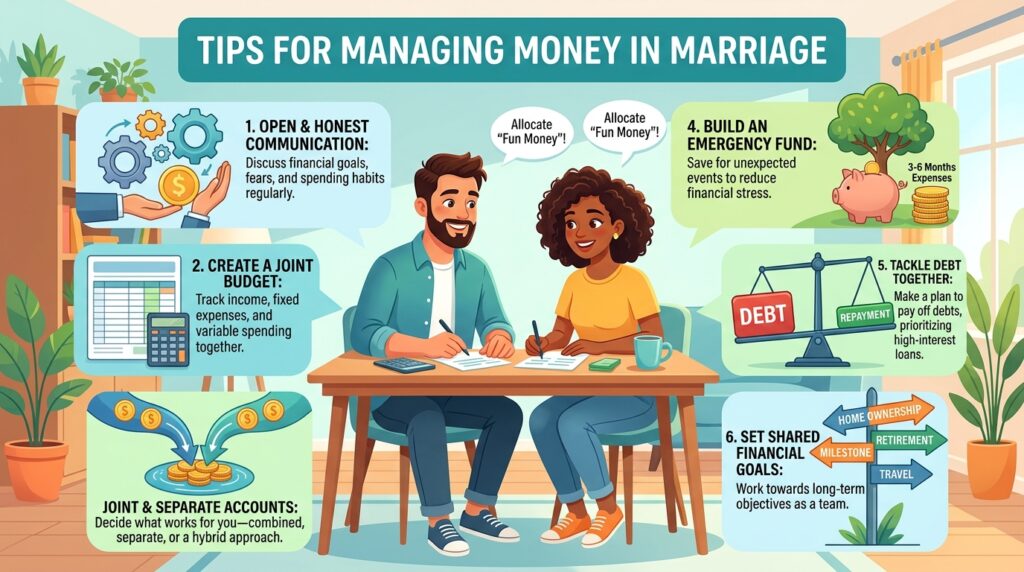
Managing money in a marriage is one of the most practically complex and emotionally loaded challenges that couples face. It requires combining two financial histories, often two different incomes, different spending personalities, and different ideas about what money is for — all while navigating the day-to-day reality of shared expenses, competing priorities, and an uncertain future.
The couples who do it well tend to share certain habits and approaches. They’re not necessarily the wealthiest couples or the most financially sophisticated ones. They’re the ones who have figured out how to talk about money honestly, make decisions collaboratively, and build systems that work for both of them.
Here is what financial experts, therapists, and research on couples’ finances consistently recommend.
Have the Full Financial Disclosure Conversation Early
Financial therapist and researcher Dr. Brad Klontz, co-author of Mind Over Money, emphasizes that one of the most important things couples can do — ideally before marriage, but never too late afterward — is to have a complete financial disclosure conversation.
This is different from the casual financial conversations most couples have. It involves laying out the full picture: income, assets, debts, credit score, spending habits, financial goals, and financial fears. Everything on the table, no omissions.
This conversation feels uncomfortable for many couples, partly because it requires vulnerability and partly because the information revealed can be surprising. But financial therapists are clear that surprises after marriage — discovering debt you didn’t know existed, or that your partner’s savings are significantly different from what you assumed — are far more damaging than awkward pre-marital conversations.
The goal isn’t to have identical financial situations. It’s to walk into the shared enterprise of marriage with accurate information, so you can make real plans rather than plans based on assumptions.
Agree on a Financial Structure Before Defaulting to One
There are three broad models for how married couples manage money: fully merged finances (everything goes into shared accounts), fully separate finances (each person manages their own money independently and splits shared costs), and a hybrid model (separate personal accounts plus a shared account for joint expenses).
Each of these models can work. Each has real advantages and real limitations. The mistake most couples make is not choosing deliberately — they default to a structure because one partner is more assertive about it, or because it’s what their parents did, or simply because it’s what happened.
Financial advisors consistently recommend the hybrid “yours, mine, and ours” model as the most effective for most married couples. A joint account is funded by both partners (proportionally or equally, depending on income and preference) and covers shared expenses: housing, utilities, groceries, shared savings goals. Each partner also maintains a personal account with a pre-agreed personal spending allowance — money that is theirs to use however they choose without accountability to the other partner.
This structure balances the financial unity that marriage involves with the personal autonomy that individuals need to feel respected and in control of some aspect of their financial life. It also reduces the most common day-to-day financial friction points.
Whatever structure you choose, choose it consciously, discuss it explicitly, and revisit it when life circumstances change.
Set Short, Medium, and Long-Term Financial Goals Together
Certified financial planner Stacy Francis, founder and CEO of Francis Financial, advises married couples to have explicit financial goals at three time horizons: the next 12 months, the next three to five years, and a longer-term view of retirement and major life milestones.
Short-term goals might include building an emergency fund, paying down a specific debt, or saving for a vacation. Medium-term goals might include saving for a down payment, funding a child’s education, or hitting a particular net worth milestone. Long-term goals center on retirement readiness and estate planning.
Having goals at all three levels gives couples a framework for financial decision-making. When a spending decision comes up, it can be evaluated against those goals: Does this bring us closer to or further from what we said we wanted? This removes a significant amount of the conflict from individual financial decisions, because the criteria are already agreed upon.
It also creates a shared sense of direction that makes financial discipline feel purposeful rather than arbitrary. You’re not saving because saving is virtuous in the abstract — you’re saving because you have a specific vision for your life together that requires it.
Revisit Finances Regularly — Not Just in Crisis
Many married couples have their most intensive financial conversations when something has gone wrong: an unexpected expense, a job loss, a credit card bill that’s gotten out of hand. The result is that financial conversations become associated with stress, conflict, and bad news.
The solution is to make financial conversations a regular, scheduled part of married life — not a crisis response. Most financial advisors recommend monthly budget check-ins (15-30 minutes to review the previous month’s spending and upcoming costs) and a more comprehensive annual review (a couple of hours to assess progress toward goals, review insurance and estate planning, and adjust the financial plan for the year ahead).
These regular meetings serve multiple purposes. They keep both partners genuinely informed about the household’s financial situation. They surface small problems before they become large ones. They create a habit of financial collaboration rather than financial avoidance. And they allow couples to celebrate wins — reaching a savings milestone, paying off a debt — rather than only discussing money when there’s a problem.
Understand Each Other’s Financial Personality
Research by financial psychologists has identified distinct financial personality patterns — tendencies in how people relate to money that shape spending, saving, and risk-taking behavior. Understanding your own financial personality and your partner’s is foundational to managing money together effectively.
Common financial personality patterns include:
The Hoarder: Finds deep security in saving and experiences significant anxiety when money is spent, even on things that are reasonable and enjoyable.
The Spender: Derives pleasure and a sense of vitality from spending, tends to live in the present financially, and may underweight future planning.
The Avoider: Feels overwhelmed and anxious around financial matters, tends to disengage from financial management, and avoids looking at account balances or opening bills.
The Worrier: Chronically anxious about money regardless of the actual financial situation, tends to catastrophize financial problems.
The Risk-Taker: Comfortable with financial uncertainty, may pursue high-risk high-reward financial decisions that create stress for a more conservative partner.
Most people are a blend of these patterns. The value in naming them is that it depersonalizes financial conflict: “I’m not being reckless; I’m wired to be more comfortable with risk” is easier to work with than “you’re always judging how I spend money.”
Understanding your patterns allows you to design financial structures and conversations that accommodate both personalities rather than requiring one person to simply become different.
Keep Each Other Fully Informed
One of the most common and damaging patterns in married couples’ finances is one partner taking primary responsibility for financial management while the other remains disengaged. This happens for legitimate reasons — one person may be more interested, more skilled, or have more time to devote to financial management.
The problem is not the division of labor. The problem is when the non-managing partner is genuinely uninformed about the household’s financial situation: doesn’t know account numbers, doesn’t know where documents are kept, doesn’t understand the investment strategy, has no access to key financial information.
This creates several risks. If the managing partner becomes incapacitated or if the marriage ends, the other partner is left scrambling. It also creates an unhealthy power imbalance — the managing partner holds significant information and decision-making power, while the other partner is effectively dependent.
Both partners should know: where all accounts are held and how to access them, the full picture of income, expenses, and debts, where important financial and legal documents are kept, who the household’s financial advisors or accountants are, and the household’s overall financial trajectory.
The non-managing partner doesn’t need to be equally involved in day-to-day financial administration. But they need to be genuinely informed.
Plan for Financial Asymmetry
Many married couples face periods where one partner earns significantly more than the other — during graduate school, career transitions, parental leave, or if one partner steps back from paid work to manage the household. These periods of financial asymmetry can be unexpectedly destabilizing if couples haven’t planned for them.
The core issue is that without intentional planning, financial asymmetry can create a dynamic where the higher earner has more power and the lower earner feels financially dependent, which can be deeply uncomfortable and damaging to both self-esteem and the relationship’s sense of equality.
Financial planners recommend that couples discuss these periods explicitly: How will personal spending money be allocated when one person isn’t earning? Who makes decisions about larger purchases? How do we preserve the non-earning partner’s sense of financial agency?
Treating the non-earning or lower-earning partner’s contribution — whether as a caregiver, household manager, or support to the other’s career — as economically valuable, and ensuring they have genuine financial agency during this period, preserves the partnership’s sense of equality.
Build in Financial Safety Nets for Each Partner
Marriage is a deep financial partnership, but healthy financial partnership does not mean complete financial fusion. Financial advisors recommend that both partners maintain some degree of independent financial life, even within a fully merged marriage.
This means each partner having: their own credit history (at least one credit card in their own name, actively used and paid off), some awareness of financial institutions and how to access accounts, and ideally some savings in their own name.
This isn’t preparation for divorce. It’s basic financial resilience. Both partners should be able to function financially as individuals if they ever needed to — whether due to the death of a spouse, a medical incapacity, a job loss, or any other life disruption.
Work With Financial Professionals Together
Many couples use financial advisors, accountants, or financial planners — but often only one partner is engaged in those professional relationships. The other attends appointments reluctantly, follows along without fully engaging, or doesn’t attend at all.
Financial experts recommend that both partners be actively involved in relationships with financial professionals. Attend appointments together. Ask questions. Make sure both partners understand the financial strategy, not just receive updates on it.
This is particularly important for legal and estate planning: wills, beneficiary designations, power of attorney, and healthcare proxies. These are decisions that both partners need to understand and be part of, because they govern what happens when one or both partners is unable to manage their own affairs.
Money and Marriage: The Long Game
Managing money in marriage is not a problem you solve once. It’s a continuous, evolving practice — one that requires adapting to changing incomes, shifting goals, new life stages, and the ongoing process of understanding each other more deeply.
The couples who manage it best aren’t those who never disagree about money. They’re those who have built enough trust, honesty, and mutual respect that financial disagreements are navigable — part of the normal work of building a shared life, rather than threats to the foundation of the relationship.
Start wherever you are. Have the conversation you’ve been avoiding. Schedule the meeting you’ve been putting off. The earlier you begin, the more compounding benefit you’ll get — financially and relationally.