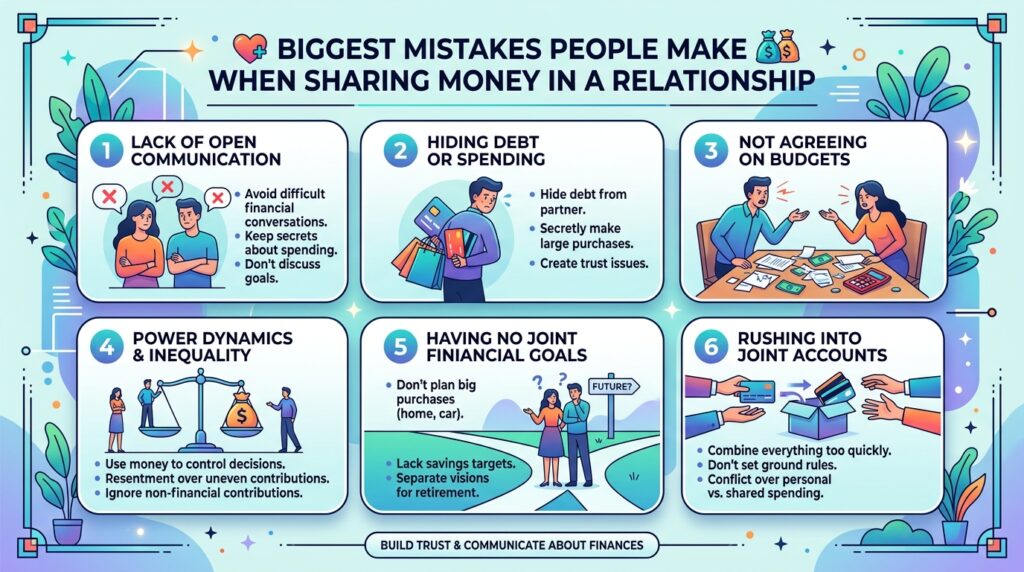
Money is one of the leading causes of conflict in romantic relationships — and according to multiple surveys and studies, it consistently ranks among the top reasons couples divorce. This isn’t simply because having or not having money is stressful (though it is). It’s because money carries meaning. It’s tied up with identity, power, security, love, and values in ways that make financial conversations loaded even when the numbers aren’t particularly dramatic.
Couples who navigate money well don’t necessarily earn more or spend less than couples who struggle. What they do differently is how they think about money together, how they communicate about it, and what mistakes they’ve learned — or managed — to avoid.
Here are the biggest financial mistakes couples make when sharing money, and what to do instead.
Mistake 1: Never Having a Direct Conversation About Money
A surprising number of couples merge their lives — sharing homes, having children, making major purchases together — without ever sitting down to have an explicit, honest conversation about their financial situation, habits, and values.
This happens for understandable reasons. Money is personal. Talking about income can feel embarrassing or vulnerable. People have shame around debt or spending habits. And for many couples, especially in the early stages of a relationship, financial conversations seem premature or unromantic.
But avoidance doesn’t make financial incompatibility go away. It just ensures that incompatibilities surface unexpectedly and explosively — when one partner discovers the other’s debt, when a major financial decision creates conflict, or when different spending philosophies start pulling the household in opposite directions.
Couples who have explicit early conversations about income, debt, savings habits, financial goals, and money values have a significant advantage. These conversations don’t need to be confrontational. Approached with curiosity rather than judgment, they’re an opportunity to understand your partner on a level that most people skip.
Mistake 2: Assuming You Have the Same Financial Values
Even couples who have had some financial conversations often make the assumption that their general approach to money aligns. It frequently doesn’t.
Financial values run deep. One partner might be a natural saver who finds security in knowing there’s a cushion — the other might be a natural spender for whom money represents enjoyment and quality of life. One person may have grown up in financial scarcity and carry anxiety around spending; the other may have grown up in comfort and have a more relaxed relationship with money.
Neither approach is inherently right or wrong. But without explicitly naming these differences and working out a framework that respects both perspectives, financial decisions become a constant source of low-grade tension. The saver feels anxious and resentful. The spender feels criticized and controlled. Both feel misunderstood.
Identifying your financial personalities — not to judge each other but to understand where you’re each coming from — is the foundation of effective financial management as a couple.
Mistake 3: The “What’s Mine Is Mine” Trap in Fully Merged Finances
Some couples fully merge their finances early in the relationship, combining all income into shared accounts and treating everything as joint money. When this works, it can create a powerful sense of partnership and shared purpose.
The problem arises when partners don’t also maintain some individual financial autonomy — even a small personal account for discretionary spending. When every purchase is shared and potentially subject to scrutiny or judgment from the other partner, it can create a dynamic where one or both people feel financially controlled.
This is particularly common in relationships where one partner earns significantly more than the other. The higher earner may feel entitled to have more say over how money is spent. The lower earner may feel they have to justify even small personal expenses. This dynamic, left unaddressed, breeds resentment and erodes the sense of equal partnership.
Many financial therapists recommend a “yours, mine, and ours” model: a shared account for joint expenses and goals, and individual accounts for each partner’s personal spending — no questions asked. This structure gives couples the benefits of collaboration while preserving individual dignity and autonomy.
Mistake 4: Letting One Person Handle All the Finances
In many relationships, financial management falls to one partner — either by agreement, default, or one partner’s greater interest and competence in financial matters. This division of labor is not inherently problematic. The problem arises when the other partner is completely disengaged from the household’s financial life.
If the partner who manages money becomes ill, incapacitated, or if the relationship ends, the other person can find themselves suddenly responsible for finances they have no understanding of — accounts they don’t know about, bills they haven’t tracked, and decisions they’ve never been part of.
Beyond the practical risks, financial disengagement often creates a power imbalance. The managing partner holds information and control. The disengaged partner may feel unable to weigh in on financial decisions because they don’t know enough to do so meaningfully.
Both partners should be genuinely engaged in the household’s finances. One person can take the lead on day-to-day management, but both should attend regular financial check-ins, understand the full picture of income and expenses, and participate meaningfully in major financial decisions.
Mistake 5: Having No Shared Financial Goals
Couples who manage money well are typically working toward something together. Whether it’s saving for a home, building an emergency fund, paying off debt, or planning for retirement — shared goals create financial alignment and make the sacrifices involved in budgeting feel purposeful rather than punishing.
Without shared goals, financial management becomes an exercise in constraint with no compelling reason behind it. Spending restrictions feel arbitrary. Saving feels joyless. Disagreements about money feel abstract and recurring because there’s no north star to orient the decisions.
Sitting down regularly — at least once or twice a year — to articulate shared financial goals for the next 12 months and the next several years gives your financial decisions a framework. It also gives you something to celebrate when you reach milestones, which is a powerful bonding experience in itself.
Mistake 6: Treating Income Differently Based on Who Earns It
In couples where both partners work, it’s common for financial tensions to arise around the idea of “my money” versus “your money” — even in ostensibly shared finances. The partner who earns more may feel entitled to more say in how it’s spent. The partner who earns less may feel their contribution is undervalued or that they need to defer on financial decisions.
This dynamic is particularly fraught in relationships where one partner steps back from paid work — perhaps to care for children — and suddenly lacks “their own” income. Research consistently shows that this transition can significantly affect the non-earning partner’s sense of financial autonomy and self-worth in the relationship.
Financial therapists are clear: in a committed partnership, both partners’ contributions — financial and otherwise — are part of the shared enterprise. The staying-at-home partner is contributing economic value that would otherwise have to be paid for. The earning partner is benefiting from the other’s labor. Treating the income as belonging to the earner rather than the partnership creates inequality that causes lasting damage.
Mistake 7: Not Planning for Financial Emergencies
Survey after survey shows that a significant proportion of couples — across income levels — have inadequate emergency savings. The recommendation from most financial experts is to maintain three to six months of essential expenses in an accessible savings account. Few couples actually do this.
The practical consequences of this gap become painfully clear when emergencies arrive: a job loss, a medical event, a major car or home repair. Without an emergency fund, couples face sudden financial pressure that strains even otherwise strong relationships.
Building an emergency fund isn’t glamorous. It often requires delaying other spending priorities. But couples who treat it as non-negotiable — contributing to it consistently before other discretionary spending — have a financial buffer that dramatically reduces the stress and conflict that comes with unexpected events.
Mistake 8: Keeping Financial Secrets
Financial infidelity — hiding purchases, accounts, debt, or financial behavior from a partner — is more common than many people realize. A 2021 survey by the National Endowment for Financial Education found that 43% of adults who combined finances with a partner had committed some form of financial deception.
The reasons are varied: shame about spending habits, fear of judgment, a desire for independence, or the knowledge that the purchase would create conflict. But hidden financial behaviors erode trust in the same way other forms of deception do — and the discovery of financial secrets is consistently among the triggers for serious relationship crises.
The solution isn’t total financial surveillance of each other. It’s the combination of genuine financial transparency on major matters and agreed-upon personal spending money that gives each partner some financial privacy without secrecy. When both people feel they have a reasonable degree of financial autonomy, the temptation to hide things diminishes.
Money doesn’t have to be a source of chronic conflict. For the couples who handle it well, it often becomes one of their strongest collaborative domains — a shared project that brings them closer rather than driving them apart.
The difference between those couples and the ones for whom money is a persistent source of stress is rarely about income or net worth. It’s about how honestly, how regularly, and how respectfully they talk about it.