There’s a version of love that lives in movies, romance novels, and social media feeds — one where couples never raise their voices, always know exactly what the other person needs, and somehow glide through life without conflict, resentment, or doubt. It looks beautiful. It also doesn’t exist.
Yet millions of people are measuring their real relationships against this fictional standard and quietly concluding that something must be wrong with them — or their partner. Relationship therapists say this gap between expectation and reality is one of the leading causes of unnecessary breakups, chronic dissatisfaction, and emotional withdrawal in otherwise healthy relationships.
This article breaks down the most persistent myths about “perfect relationships” — myths that feel true, that well-meaning people pass on to each other, and that quietly do a lot of damage.
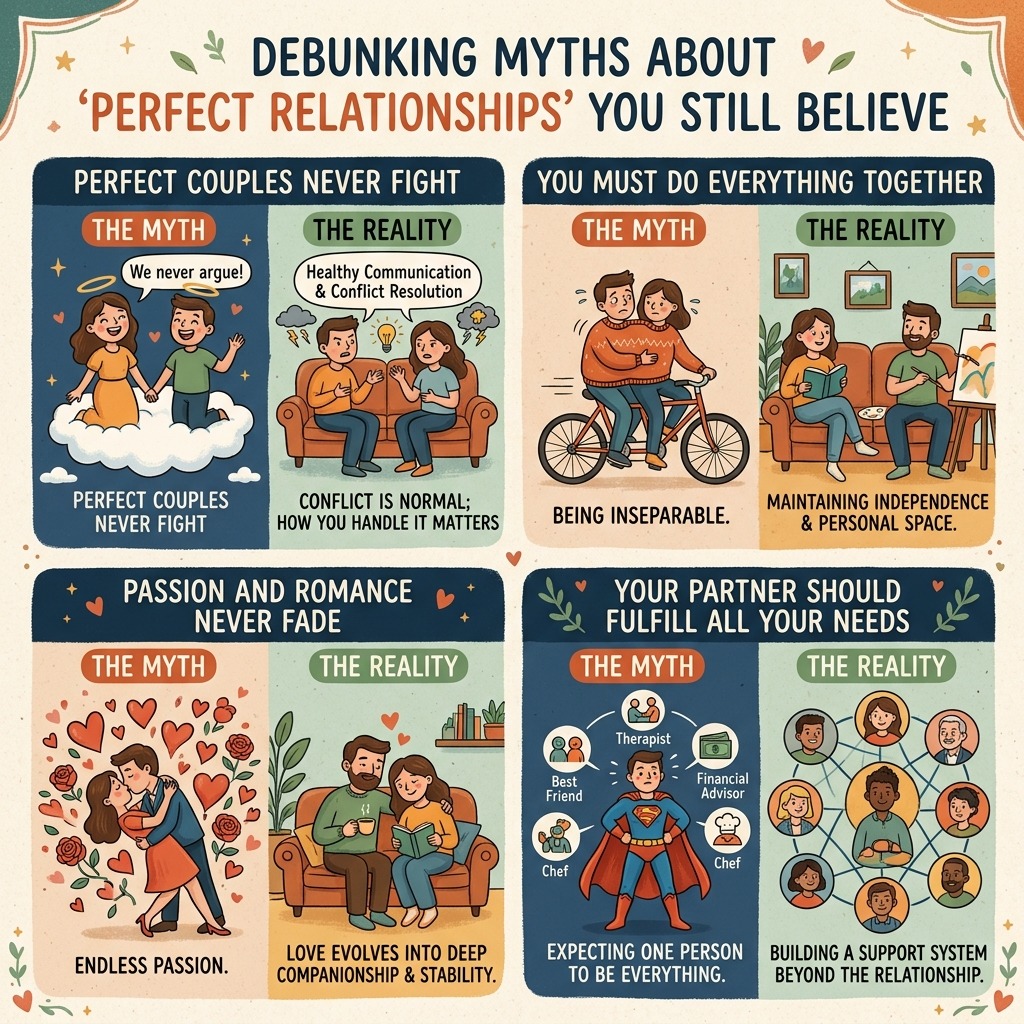
Myth 1: Happy Couples Don’t Fight
This is perhaps the most widespread myth in relationship culture. Many people genuinely believe that the absence of conflict is a sign of a healthy relationship. In reality, research suggests the opposite may be closer to the truth.
Dr. John Gottman, a psychologist who has spent over four decades studying couples at the University of Washington’s “Love Lab,” found that conflict is not the problem — it’s how couples handle conflict that determines whether a relationship thrives or deteriorates. His research identified that even the most satisfied couples disagreed regularly. The difference was that they fought fairly, stayed emotionally engaged, and avoided contempt.
Couples who never fight often aren’t conflict-free. They’re conflict-avoidant. And that avoidance tends to build resentment over time — unspoken grievances that accumulate silently until they explode in ways that feel disproportionate or, worse, lead to emotional disconnection where one or both partners simply stop trying.
Healthy disagreement, handled with respect and a genuine desire to understand the other person, is not a sign of a broken relationship. It’s a sign of two people who care enough to be honest.
Myth 2: Your Partner Should Complete You
“You complete me” is one of the most quoted lines in romantic film history. It’s also a deeply problematic idea to carry into a real relationship.
The belief that your partner is your “other half” — that they exist to fill a void in you, to make you whole — places an impossible burden on another human being. No person can be everything to someone else. When we expect a partner to be our therapist, best friend, cheerleader, spiritual guide, financial advisor, and passionate lover all at once, we set them up to fail us. And when they inevitably fall short in some of those roles, it reads as a sign that the relationship is broken.
Psychologists who specialize in attachment theory describe the healthiest relationships as those between two people who are each reasonably whole on their own. This doesn’t mean self-sufficient to the point of not needing anyone — humans are inherently social beings. It means having your own identity, interests, friendships, and sense of self-worth that doesn’t depend entirely on whether your partner is happy with you today.
Strong couples are interdependent, not codependent. They choose each other from a place of desire rather than desperation.
Myth 3: If It’s the Right Person, It Shouldn’t Be Hard
Modern dating culture has popularized the phrase “when you know, you know” — the idea that the right relationship is effortless, that love with the right person just flows. This myth keeps people leaving relationships the moment things get difficult, always searching for the easier love they’ve been told is out there.
Every long-term couple will tell you: maintaining a relationship takes work. Not miserable, grinding labor — but real, intentional effort. Communication has to be practiced. Forgiveness has to be chosen. Habits that hurt your partner have to be recognized and changed. Priorities shift over years, and couples have to grow together rather than apart.
Licensed marriage and family therapist Esther Perel, whose work on modern relationships has reached global audiences, often argues that the idea of effortless love is a modern invention. For most of human history, love was understood to be something cultivated, not merely discovered. The effort was expected. It was part of the commitment.
Difficulty in a relationship doesn’t mean you chose the wrong person. It often means you’ve reached a level of intimacy deep enough to expose real differences — and that’s where real growth happens.
Myth 4: Good Relationships Are Always Passionate
In the early stages of romantic love, passion feels almost involuntary. You think about the other person constantly. Physical attraction is intense. Conversations feel electric. Neuroscience explains why: the brain floods the system with dopamine and norepinephrine during this phase, creating something close to a natural high.
That phase doesn’t last. Neurologically, it can’t. But many people interpret its fading as evidence that the love is dying — and either panic or give up.
What actually happens in long-term relationships, when they’re healthy, is that early passion transitions into what researchers call “companionate love” — deeper, calmer, and more stable. It’s less a rollercoaster and more a steady foundation. Studies have found this form of love is actually more associated with long-term happiness and well-being than the turbulent passion of early romance.
Some couples do maintain sparks over decades — not because passion naturally sustains itself, but because they actively invest in novelty, romance, and physical connection. The couples who give up because the butterflies are gone often don’t realize that what they have is something better — if they’re willing to nurture it.
Myth 5: A Perfect Partner Will Know What You Need Without Being Told
This myth might be the single most damaging one on this list. The belief that a truly loving partner will just know — your needs, your moods, your boundaries, your desires — without you having to articulate them is responsible for an enormous amount of silent suffering in relationships.
It’s rooted in a romantic idea that love comes with mind-reading. In practice, it creates a scenario where people feel perpetually unheard and unseen, not because their partner doesn’t care, but because their partner literally doesn’t know what they need.
Effective communication in relationships isn’t a workaround for a poor connection. It IS the connection. Research consistently shows that couples who express their needs clearly and listen actively to their partner’s needs report significantly higher relationship satisfaction.
If you’ve been waiting for your partner to “just get it,” consider that they may be trying and simply guessing wrong. Tell them what you need. Then tell them again when things change. That’s not a sign of incompatibility — it’s what intimacy actually looks like.
Myth 6: Jealousy Means Love
There’s a persistent cultural story that jealousy is proof of love — that if your partner isn’t at least a little jealous, they don’t care enough. This conflation of jealousy with love is not just inaccurate; it’s potentially dangerous.
Jealousy is primarily a response to perceived threat and insecurity. In small doses and handled maturely, it can prompt a conversation about needs or reassurance. But when jealousy is treated as a sign of love and therefore normalized — or even encouraged — it creates an environment where controlling behavior gets romanticized.
Research in psychology clearly identifies intense jealousy as a risk factor for emotional and physical abuse in relationships. Healthy love is characterized by trust, security, and the freedom for each partner to exist as an individual. If jealousy is constant and controlling in your relationship, it warrants serious attention — not celebration.
Myth 7: Successful Relationships Never Need Outside Help
Seeking therapy or counseling is still, in many communities, seen as a sign that a relationship is in serious trouble — a last resort before giving up. This stigma keeps many couples from getting support they could benefit from at far earlier stages.
In reality, couples therapy is most effective when couples seek it before things reach a crisis point. Research from the American Association for Marriage and Family Therapy shows that over 97% of couples who seek therapy report it as helpful. And yet, studies suggest that couples wait an average of six years after problems begin before seeking professional help.
Seeing a therapist doesn’t mean your relationship is failing. It means you care about it enough to invest in it — the same way you’d see a doctor not only when you’re gravely ill but also for preventive care.
Perfect relationships don’t exist. What does exist — for people who are willing to let go of the myth — is something messier, realer, and ultimately more satisfying: a relationship built on honest communication, mutual respect, willingness to grow, and the quiet, daily choice to keep showing up for each other.
The couples who last aren’t the ones who never struggle. They’re the ones who stopped expecting perfection and started building something true.
If your relationship doesn’t look like the ones in movies, that might be the best sign of all.